
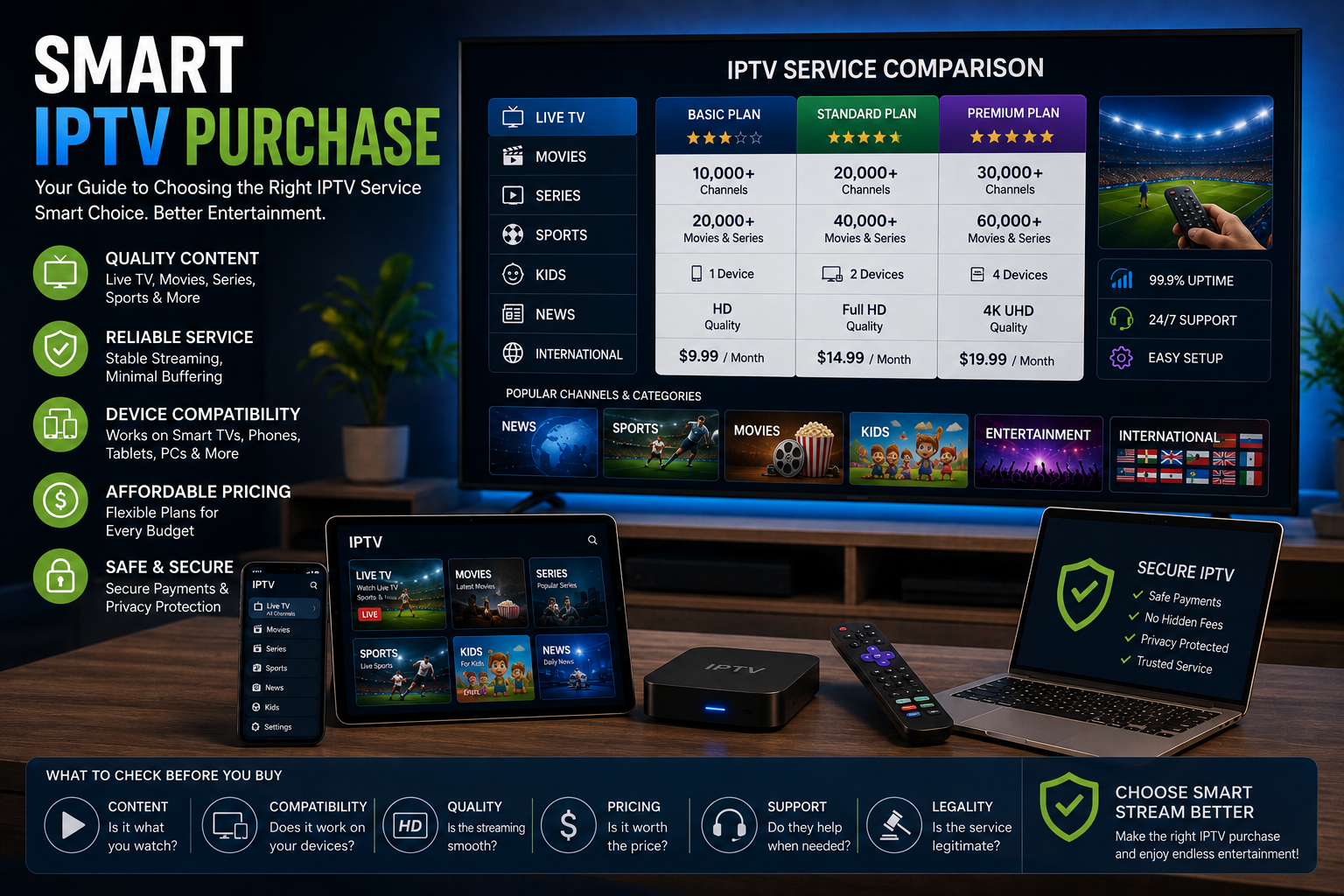
Buying IPTV can look easy. Pick a plan, pay, get login details, and start streaming. In real life, a smart IPTV purchase depends on more than price. Before you buy IPTV, check content rights, device fit, support, stream stability, and the real shape of the offer.
This guide helps you compare IPTV plans, review IPTV deals, and make a better IPTV purchase. It also explains how to purchase IPTV subscription access without guessing what you are getting.
What should you check before buying IPTV services?
Before buying IPTV services, check whether the provider is open about its business, content, devices, and support. A good service should say what you pay for, how access works, which apps or devices it supports, and what happens if streams fail.
If an offer feels secretive, oddly cheap, or built around confusing codes with no real support, treat it carefully.
The best choice is not always the cheapest one. An IPTV subscription is only useful if it works, fits the shows you watch, and does not bring avoidable safety, privacy, or legal risk. Start with questions, not the payment page.

Understanding what IPTV really offers
IPTV means TV over the internet, not cable or satellite. That gives you more device choice. You may watch on smart TVs, streaming sticks, phones, tablets, browsers, or computers. Many people look at IPTV options because they want live channels, on-demand shows, sports, international content, or niche programs.
Not every provider works the same way. Some IPTV providers are licensed brands with clear rights. Others bundle channels, playlists, or login details and leave content rights unclear. That gap matters because it affects trust, payment safety, and the long-term value of your IPTV account purchase.
Some IPTV providers offer their own apps. Others give login details, playlist links, or activation data for third-party players. That is why terms like IPTV code purchase, IPTV account purchase, and IPTV Smarters Pro purchase can confuse buyers. In many cases, the app and the content plan are separate. IPTV Smarters Pro is often just a player, not a content plan.
Trust and content rights come first
The first question is whether the service looks real and stable. A responsible provider should be clear about its name, terms, regions, plan rules, and content access. If a provider claims to offer huge channel lists, pay-per-view events, new movies, and global sports for a tiny price, ask more questions.
This is especially important because unauthorized IPTV services can be shaky and risky. Access may stop without warning. Payment may offer little recourse. Support may vanish after the sale. Some risky services also push users toward side-loaded apps, unknown files, or payment paths that reduce accountability.
Before you purchase IPTV, look for these trust signals:
- A clear website with contact info and terms
- Transparent plan details instead of vague channel claims
- Secure checkout methods from known payment processors
- Clear notes on content packages and regions
- Setup, troubleshooting, and renewal help
- No pressure to pay through unusual or one-way methods
- No promises that sound too broad to be real
Trust also matters for daily use. If you want IPTV services for everyday home use, business use, hotel settings, or shared family viewing, you do not want a service that could fail during a big event or need constant workarounds.
Device fit should guide your choice
Before making an IPTV purchase, confirm device fit. Check support for your smart TV, Android TV box, Apple TV, Fire TV device, phone, tablet, browser, or set-top box. Do not assume that support for all devices means the setup will be easy.
Useful questions:
- Which devices are officially supported? Look for specific device names, not broad claims.
- Is there a recommended app? If the service depends on a third-party app, check whether it is easy to get from an official store.
- How many devices can stream at once? A single connection may not be enough for a family or shared home.
- Can you switch devices later? Some accounts may be locked to one device, app, or MAC address.
- Are setup guides available? Screenshots, step-by-step notes, and support links are signs of a more organized provider.
How to compare IPTV pricing and plans
Compare IPTV pricing by looking at total value, not just the monthly fee. Check the number of connections, content categories, video quality, on-demand access, trial access, cancellation terms, renewal steps, and support quality. A lower price may look good, but weak servers or poor service can make it cost more in lost time.
IPTV plans often vary by length, content range, connection count, and extras. Short plans may cost more each month but reduce risk if you are testing. Longer plans can look like better IPTV deals, but they need more trust because you are paying ahead.
When you purchase IPTV subscription access, focus on the full plan, not just the sticker price.
Consider these pricing factors:
- Plan length: Monthly, quarterly, yearly, or custom plans each carry different risk levels.
- Simultaneous streams: More connections help if several people watch at once.
- Content focus: Sports, movies, regional channels, kids’ content, international programming, and on-demand libraries may vary by plan.
- Video quality: HD or 4K claims depend on your internet speed, device, and provider setup.
- Trial access: A paid or short trial can help you test before you commit.
- Renewal terms: Check whether renewal is manual, automatic, or handled through a reseller.
- Refund policy: Clear refund rules are better than vague promises.
A fair IPTV pricing structure should be easy to follow. If you need to message someone again and again just to learn the plan length, included channels, or payment method, that is not a great start.
Stream quality depends on more than speed
Internet speed matters, but it is not the only thing that shapes IPTV quality. Stable streaming also depends on server load, content source quality, routing, device power, app quality, and your home network. A provider can advertise HD or 4K streams, but if the servers are busy at peak times, you may still see buffering.
Think about when you watch. Sports fans need strong live performance. Families may need stable evening use across several rooms. International viewers may care about channel availability and time-based guides.
A practical test:
- Test the channels you care about.
- Watch for several minutes.
- Try peak times.
- Compare Wi-Fi with Ethernet.
- Restart the app and device.
- Check channel change speed.
- Confirm guide data loads correctly.
If a provider offers a trial, use it during your normal routine, not just to see if it opens.
Content should match your real viewing habits
Large channel counts can sound good, but they do not always help. Ask which content you really use. Start with your must-have categories. Maybe you care about local news, a sports league, regional channels, kids’ content, movies, docs, or catch-up TV.
Write down your priorities before entering an IPTV shop or comparing IPTV bundles. That helps you avoid paying for a huge package that does not fit your home.
Also consider language and region. Some IPTV services focus on certain countries or languages. Others offer broad entertainment. If you need regional content, ask for current package details or a trial.
To narrow your choices:
- List your top ten channels or content types. These are your must-haves.
- Separate nice-to-have content from must-have content. This keeps you from paying for extras you do not need.
- Check whether on-demand libraries are current and easy to browse. A large library is less helpful if it is hard to use.
- Review guide data and categories. Good organization makes daily use much easier.
- Avoid buying based only on screenshots. Screenshots can be old or selective.
A good IPTV subscription should feel easy after the first week, not just exciting on day one.
Support quality matters after the sale
Support is easy to ignore until something breaks. IPTV services depend on apps, servers, passwords, devices, internet links, and sometimes third-party players. When one part fails, good support saves time.
Before you complete an IPTV account purchase, check how support works. Is there live chat, email, ticket support, docs, or a chat app? Are setup guides clear? Does the provider explain buffering, login errors, device limits, expired plans, or app setup?
A helpful provider should not send credentials and disappear. They should help you turn on service, manage renewals, and fix basic issues. If support is slow before you pay, it may not get better later.
Look for support signals:
- Clear setup steps for each supported device
- A direct way to contact support
- Realistic response times
- Renewal reminders or account tools
- Troubleshooting help for common errors
- Clear split between app problems and service problems
- Professional replies without pressure
If you are new and learning how to purchase IPTV, a beginner-friendly provider should explain portals, playlists, players, and activation codes in plain language.
Payment safety and privacy deserve attention
Any online subscription needs trust. With IPTV, that trust covers payment details, account data, device data, and sometimes viewing history. Before you buy IPTV, check whether the checkout page is secure and whether the provider explains billing, refunds, privacy, and account access.
Be careful with sellers who only accept hard-to-dispute payment methods. Some small providers use alternative payments, but less payment protection means more risk if the service fails. Also be careful with requests for extra personal data. A provider needs enough data to make and support your account, but too much data should make you pause.
Privacy also applies to apps and files. Avoid unknown downloads from random links unless you know the source. Use apps from official stores or well-known developers when you can. Keep devices updated, use strong passwords, and do not reuse the same password everywhere.
A safer payment and privacy checklist:
- Use secure checkout pages when possible.
- Read refund and cancellation terms before paying.
- Share only the data needed for the account.
- Be careful with unknown app files.
- Use unique passwords for streaming accounts.
- Keep device software up to date.
- Save receipts, order numbers, and support messages.
A smooth IPTV purchase should leave you with clear records, not just a chat and a promise.
What are the warning signs of a risky IPTV provider?
Warning signs include huge channel claims, unclear ownership, no refund policy, poor replies, odd payment requests, and pressure to buy long plans right away. Be careful with providers that promise every premium channel, every sports event, and every movie for a price far below normal market levels. If the offer seems made to block questions, step back.
Risky providers often use urgency. They may push limited-time IPTV deals, big discounts, or lifetime access without saying how the service stays alive. Lifetime plans are worth extra caution because streaming services need ongoing support, servers, and content access. If the seller cannot explain the model, the offer may not be stable.
Red flags:
- No clear company name, terms, or contact info
- Only social media or anonymous chat for sales
- Payment due before plan details are shown
- No trial, demo, or real way to check quality
- Lifetime IPTV offers with vague rules
- Confusing use of IPTV code purchase with no explanation
- Poor grammar plus copied channel lists and generic screenshots
- Pushy support when you ask basic questions
- No info on device limits, renewals, or service breaks
A real seller should welcome fair questions. If asking about device fit, refunds, or content availability creates tension, that tells you something.
App choice affects the everyday experience
The app or player shapes the day-to-day feel of IPTV. Even if streams are good, a clunky app can make navigation hard. Guide data, favorites, search, parental controls, subtitles, and playback tools all shape the final result.
Some buyers search for IPTV Smarters Pro purchase because they think buying the app also buys content. It is better to split those choices. First, choose a provider you trust. Then check which player or app is recommended, whether it works on your device, and whether setup help is available.
A good app experience should include:
- Simple login or activation
- Clear channel groups
- Working guide support
- Favorites or custom lists
- Stable playback controls
- Compatibility with your remote or touch screen
- Updates from a trusted source
- Easy logout or account switching
If you can, test the app during a trial. Do not just check whether streams play. Check whether the app is easy to use. Good IPTV services reduce friction. They do not make every viewing session feel like a repair job.
Plan length should match your trust level
Longer IPTV plans can look tempting because they often cut the monthly rate. But a longer commitment only makes sense when you trust the provider. If you are trying a service for the first time, a short plan or trial is usually safer.
Think of plan length as a trust meter. If you have tested the service, checked device fit, reviewed support, and confirmed the content you need, a longer plan may make sense. If you are still unsure, paying for a full year just to save a few dollars can add risk.
A sensible path:
- Research and compare several IPTV providers.
- Read the plan details closely.
- Ask about devices, content, support, and renewal.
- Use a trial or short plan when you can.
- Test during normal viewing hours.
- Upgrade only after the service proves steady.
Deals and bundles need careful comparison
IPTV deals and IPTV bundles can help when they match your real needs. A bundle may include more connections, a wider content range, or a longer plan. But bundles can also push buyers toward features they never use.
Before choosing a bundle, ask what problem it solves. If your home has many viewers, extra connections may help. If you watch only a few channels, a huge package may add little. If you travel a lot, device flexibility may matter more than channel count.
To compare bundles without a table, review each option the same way:
- What content categories are included?
- How many devices or streams are allowed?
- What is the plan length?
- Is setup and troubleshooting support included?
- Are there limits on device changes?
- Is there a trial or refund window?
- What happens when the plan ends?
That keeps the comparison practical. You are not asking which plan is best in a vacuum. You are asking which plan fits your habits, home size, device setup, and comfort level.
The buying process should be clear from start to finish
When people search how to purchase IPTV, they often want a simple path. The exact steps vary by provider, but a trustworthy buying flow should be easy to follow. You should know what you are buying, how access will arrive, how to install or set up the service, and where to get help.
A clear process usually includes choosing a plan, receiving or creating account credentials, paying, following setup steps, and testing the service. If the provider uses an activation code, portal URL, or playlist, those details should come with plain instructions. If you are unsure whether you need an IPTV code purchase or a full subscription, ask before paying. A code may only activate an app or device, while a subscription usually means content access for a set time.
Before checkout, confirm:
- The plan name and length
- The number of allowed connections
- The supported devices and apps
- The content categories you care about
- The renewal and cancellation terms
- The support method after payment
- The delivery method for credentials or codes
If these basics are missing, keep looking. A good IPTV shop should make buying feel organized, not mysterious.
A practical pre-purchase checklist
Before you finish any IPTV purchase, use this checklist to slow down the choice and cut mistakes.
- Trust: The provider has clear terms, contact options, and believable service details.
- Content fit: The plan includes the channels, categories, or regions you watch.
- Device support: Your main device is supported or clearly explained.
- App clarity: You know if the app, player, code, and subscription are separate.
- Stream quality: You have tested or can test during normal viewing times.
- Connections: The plan supports the number of viewers you need.
- Support: Help is available through a clear channel, not just sales chat.
- Pricing: The cost matches the plan length, features, and your trust level.
- Payment safety: Checkout and refund terms are clear.
- Renewal: You know what happens when the plan ends.
If a provider checks most of these boxes, it may be worth a closer look. If several points are unclear, do not let a discount push you into buying too fast.
Final takeaway
Buying IPTV is less about the loudest offer and more about choosing a service that fits your viewing habits, devices, budget, and risk level. Strong IPTV services make plans clear, help with setup, explain access in plain words, and stay steady after payment. Weak providers lean on urgency, vague claims, and confusing language.
Before you purchase IPTV, compare IPTV pricing, test device fit, review support, and be honest about the content you actually watch. Whether you are looking at IPTV bundles, short-term IPTV plans, or a first-time IPTV account purchase, the smart move is to verify before you commit. A careful IPTV purchase helps you avoid frustration and choose an IPTV subscription that fits everyday viewing.
Q&A
Question: Is the cheapest IPTV subscription usually the best choice?
Short answer: Not always. A low price can look good, but the plan may have weak servers, poor support, limited device fit, or risky payment terms. A better choice is a service that works well, fits your viewing habits, and explains pricing in clear terms.
Question: Why should content rights and trust be checked before buying IPTV?
Short answer: Trust affects reliability, safety, payment protection, and peace of mind. Services that are unclear about content rights, company identity, terms, or regions may stop working without warning or leave you with little help if something goes wrong.
Question: Does buying an IPTV app mean you have bought IPTV content access?
Short answer: No. The app or player and the content plan are often separate. IPTV Smarters Pro may be a player, but buying or installing an app does not automatically include content access. Before paying, confirm whether you are buying an app activation, a code, login details, a playlist, or a full IPTV subscription.
Question: What is the safest way to test an IPTV provider before committing long term?
Short answer: Use a trial or a short plan when you can, then test the service in your normal viewing hours. Check the channels you care about, try peak times, compare Wi-Fi with Ethernet if possible, confirm guide data loads correctly, and see how support answers questions.
Question: What red flags suggest an IPTV offer may be risky?
Short answer: Warning signs include unrealistic promises, vague channel claims, no clear company name, no refund policy, odd payment requests, pushy sales tactics, lifetime access with unclear rules, and confusing language around codes or subscriptions. If the provider avoids basic questions about device fit, renewals, content, or support, it is safer to step back before you buy.