

Sling TV starts at $19.99 a month for the entry-level Essentials or Select plans, with the classic Orange and Blue lineups running about $45.99 a month each and Orange + Blue combined at roughly $60.99. Budget-conscious viewers who just want a handful of sports or news channels can go even cheaper with Sling Freestream, a free ad-supported tier, or a short-term day pass. The catch: add a couple of Extras packages and your “cheap” plan creeps toward what you’d pay for a full-service bundle.
TL;DR:
- Adding multiple Extras packages individually can raise your monthly bill to over $70, closely matching full-service cable costs, despite the low base price.
- Local affiliate deals cause channel lineups and prices to vary by ZIP code, making the advertised price and content differ depending on your location.
- The best value is achieved by choosing the smallest plan that covers your essential channels and avoiding stacking Extras without bundling deals.
- Sling’s promotional offers on premium add-ons are typically temporary, so long-term costs should be based on regular prices rather than discounts.
- Using a day pass or Freestream allows testing the service before committing to a full subscription, helping prevent unexpected expenses.
Table of Contents
- How Much Does Sling TV Cost? Plans at a Glance
- What Does Each Sling TV Plan Actually Include?
- How Add-Ons and Bundles Change Your Sling TV Bill
- Can You Try Sling TV Without a Full Subscription?
- Why Does Your Sling TV Price Depend on Your ZIP Code?
- Is Sling TV Worth the Price? Three Real Scenarios
- What Sling’s Pricing Structure Tells Us About Live-TV Value
- Where to Verify Current Sling TV Pricing
- What This Means for Choosing Your Live TV Service
- Sources
- FAQ
How Much Does Sling TV Cost? Plans at a Glance
Sling’s whole pitch is modularity. You’re not locked into one massive bundle. You pick a base plan, then decide whether you actually need the add-ons everyone else pays for without thinking twice.
Here’s what that looks like priced out, based on plan-level pricing and lineup data from independent reviews and Sling TV’s current plan breakdown.
A few things the table doesn’t tell you outright. Channel counts shift by market because local affiliate deals differ by ZIP code, so the “40+ channels” you see advertised for Blue might land a little different at your address. Orange caps you at one stream at a time, which is the single biggest reason some households skip it entirely and go straight to Blue or the bundle. And that $60.99 combined price isn’t simple addition. Orange and Blue share some channels, so Sling prices the bundle below what buying both separately would cost.
Pricing on this page reflects Sling’s current published rates. Streaming Price Tracker’s history of Sling’s pricing shows Orange and Blue both moved to $45.99 a month in late 2024, so if you remember paying less, that’s not a false memory. It’s a real increase, and worth knowing before you assume something’s wrong with your bill.
What Does Each Sling TV Plan Actually Include?
Price alone doesn’t tell you whether a plan fits your household. The lineups differ enough that picking based on price tag alone is a mistake plenty of new subscribers make.
Essentials replaced what used to be marketed separately and leans toward general entertainment and family viewing, with channels aimed at reality TV, lifestyle content, and kids’ programming. It’s the plan for someone who wants live TV running in the background without paying for sports they’ll never watch.
Select is the more sports-and-news-leaning counterpart, often including FOX News and similar channels, though exactly what you get depends heavily on your local market and affiliate agreements. Two people in different states subscribing to Select on the same day can end up with noticeably different lineups.
Orange is Sling’s original sports and family package, built around ESPN and Disney-owned content. The tradeoff is real: Orange restricts you to one stream at a time, so it’s a poor fit for a household where someone wants the game on in the living room while a kid watches something else in their room.
Blue swaps the ESPN-heavy lineup for a broader entertainment and news mix and, critically, allows three simultaneous streams. For a household with more than one person watching TV at once, that alone can justify the plan over Orange even before you compare channels.
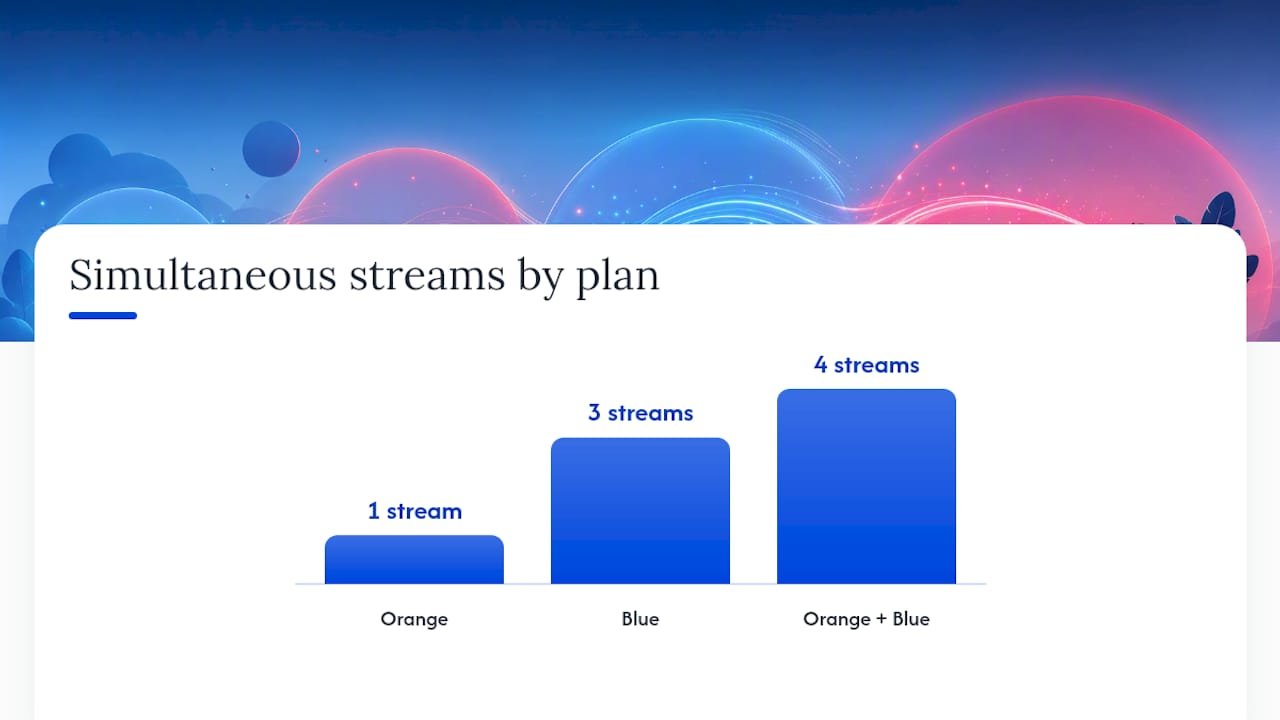
Orange + Blue exists because plenty of households don’t want to choose. You get access to both lineups and four simultaneous streams, which matters if you’ve got sports fans, news watchers, and kids all wanting different things at the same time. At $60.99 a month it’s Sling’s most expensive core plan, but it’s still frequently cheaper than a comparable cable package with similar channel depth.
A quick summary of who fits where:
- Essentials or Select: single viewers or couples with narrow, specific channel needs
- Orange: single-stream households focused on ESPN and Disney content
- Blue: multi-device households prioritizing news and general entertainment
- Orange + Blue: larger households that need broad coverage and won’t compromise on stream count
How Add-Ons and Bundles Change Your Sling TV Bill
The base plan price is only half the story. Sling’s Extras packages are where a $20 or $46 subscription quietly turns into something much closer to a traditional cable bill, and it’s worth knowing the math before you start clicking “add” on everything that looks appealing.
According to package pricing tracked by CableTV’s Sling cost breakdown, the common Extras run:
- Sports Extra: $11 a month, adding channels like SEC Network and NFL Network
- Entertainment Extra: about $6 a month
- Kids Extra: about $6 a month
- News Extra: about $6 a month
- Lifestyle Extra: about $6 a month
- Hollywood Extra: about $6 a month
- Heartland Extra: about $6 a month
Stack three or four of those onto a $45.99 Orange plan and you’re suddenly paying closer to $65 or $70 a month, which erases most of the savings that made Sling attractive in the first place.
This is where the bundle deals earn their keep. The 4 Extras Deal lets you pick four Extras packages for $13 a month total instead of paying for each individually, which can cost $24 or more separately. The Total TV Deal goes further, bundling Orange + Blue with several Extras for $21 a month on top of the base bundle price.
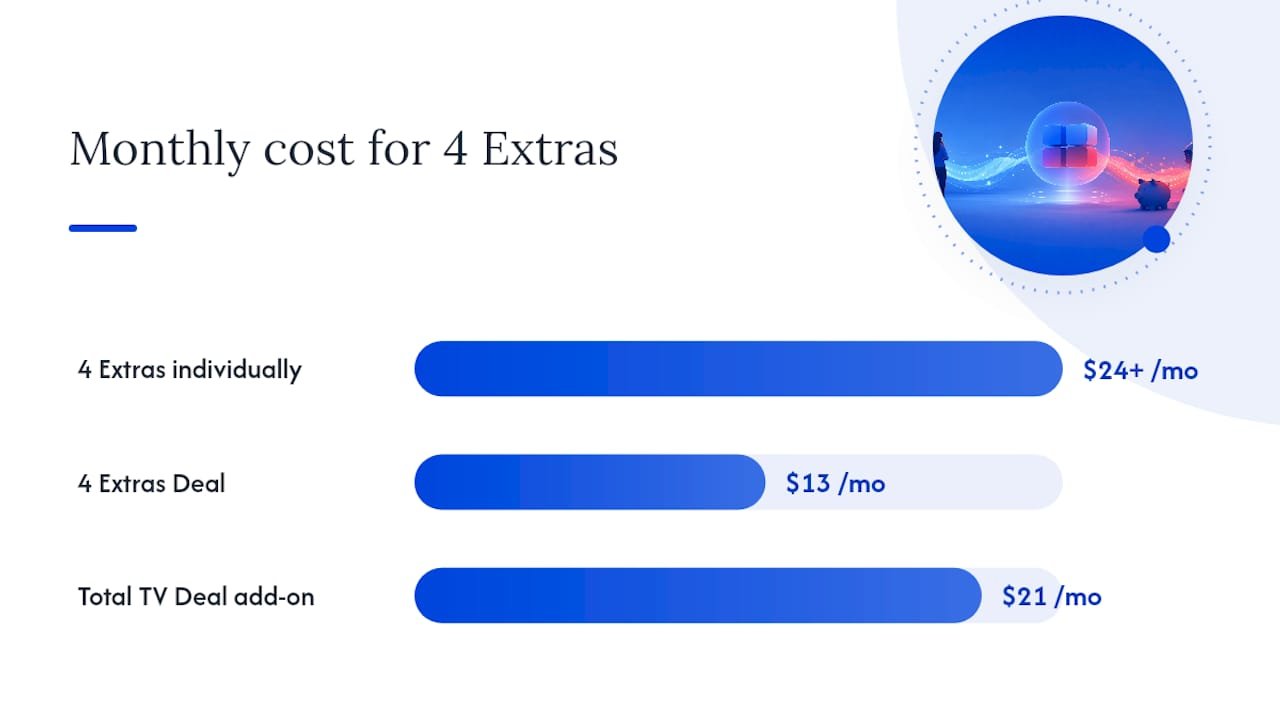
Pro Tip: Before adding a single Extra à la carte, check whether the 4 Extras Deal or Total TV Deal already covers what you want. Paying for four packs individually versus grabbing the bundle can mean the difference between $24 and $13 a month for identical content.
Sling also runs rotating promotions on premium add-ons like Paramount+, AMC+, and STARZ, often discounting the first month significantly. Those promo rates matter for your day-one bill but revert to full price after the introductory period, so don’t build your long-term budget around a first-month discount.
Can You Try Sling TV Without a Full Subscription?
You don’t have to commit to a monthly plan to watch Sling, and this is the part budget shoppers overlook most often.
- Day Pass: covers a single day of access, ideal for watching one game or event without a subscription.
- 3-Day and 7-Day Passes: extend that same idea across a weekend or a full week, useful for a tournament, a holiday, or a short trial run before committing to a monthly plan.
- Sling Freestream: a free, ad-supported tier with no subscription required, offering a slimmed-down channel lineup that won’t replace Orange or Blue but works fine for casual background viewing.
Sling no longer offers a traditional free trial, so short-term passes and Freestream have effectively become the trial alternative. New-customer promotions, including discounts on the first month and occasional student offers, show up regularly too. Prepaying for a few months at once sometimes locks in a lower effective rate, so it’s worth checking current offers before you subscribe at the standard monthly price.
Why Does Your Sling TV Price Depend on Your ZIP Code?
Two neighbors on the same street can end up with different Sling bills for reasons that have nothing to do with which plan they picked.
Local FOX and NBC affiliate inclusion varies by market, and where it’s available, it can raise the effective price of a plan compared to a market where those affiliates aren’t offered at all. This isn’t a Sling-specific quirk. It’s how local broadcast rights work across most live-TV streaming services, and reviews consistently flag address-based lineup variation as something shoppers need to check before assuming the advertised price and channel list apply to them.
Beyond the channel differences, a few billing mechanics affect your actual charge:
- Sling bills monthly by default, though prepay options for multiple months sometimes come with a discount
- Adding an Extra mid-cycle typically prorates the charge for the remainder of that billing period rather than charging a full month upfront
- Local taxes and regulatory fees can appear as a small addition to the advertised plan price, similar to how they show up on most streaming and cable bills
The practical move: before subscribing, plug in your address on Sling’s plan page and look at the actual lineup and price shown for your ZIP code. The advertised $45.99 for Blue is accurate as a base price, but your local lineup determines whether you’re getting full value at that number.
Is Sling TV Worth the Price? Three Real Scenarios
Whether Sling saves you money depends entirely on how much you build onto the base plan. Here’s what the math looks like in practice.
Scenario A: the single-sports-viewer. Someone who wants ESPN and doesn’t need multiple streams can run Orange at $45.99 a month, skip every Extra, and land near cable-replacement pricing without the multi-year contract or equipment fees. That’s about as close to Sling’s best-case value as it gets.
Scenario B: the multi-device household. A family of four watching different things at once needs Blue or Orange + Blue just to get enough simultaneous streams. Add Sports Extra and Kids Extra, and a $60.99 Orange + Blue bundle climbs toward $77 to $80 a month, still often below comparable cable packages but well above the entry-level price most people associate with Sling.
Scenario C: the add-on creep. This is the scenario that generates most of the “Sling got expensive” complaints online. Start with a $45.99 base plan, add three or four Extras individually instead of using a bundle deal, and you can push a single-stream plan past $70 a month, which starts to rival full-service alternatives.
Rough per-channel cost across live-TV streaming services tends to land somewhere in the low single digits per channel once you factor in a full plan with a couple of Extras, though this varies significantly by which packages you actually add and how many channels overlap between them.
Add-on discipline is really the whole game. A comparison of live-TV streaming options makes it clear that Sling’s advantage over full-service competitors narrows fast once you start stacking Extras that aren’t part of a bundle deal.
What Sling’s Pricing Structure Tells Us About Live-TV Value
Streaming and IPTV options can be reviewed with attention to legality, pricing transparency, and whether a service’s advertised price matches what a subscriber actually pays. Sling holds up reasonably well on that second point. Its base prices are published clearly and don’t hide behind vague “starting at” language the way some competitors do.
Where Sling gets more expensive isn’t hidden fine print. It’s optional add-ons that plenty of subscribers click through without doing the math first. The smartest approach is picking the smallest base plan that covers your must-have channels, using Freestream or a day pass to test whether you’ll actually miss anything beyond that, and calculating your realistic full monthly total, base plan plus Extras, before you subscribe rather than after your first bill arrives.
Readers weighing Sling against other paths to live TV, including legal IPTV alternatives, should apply the same discipline: compare the full monthly total, not just the headline number on a landing page.
Where to Verify Current Sling TV Pricing
For live rates, check Sling’s official plan pages directly, since promotions and prices change without much notice. Independent trackers and recent reviews add useful context on price history and where local fees might apply.
What This Means for Choosing Your Live TV Service
The conventional advice on Sling pricing treats the $19.99 headline number as the whole story, and that’s where most comparisons go wrong. The research here points to a clearer takeaway: Sling’s value depends almost entirely on add-on discipline, not the base plan you pick.
A single-stream Orange subscriber who resists Extras gets genuine savings over cable. A household stacking four individual Extras instead of grabbing the bundle deal ends up paying full-service prices for a modular service, which defeats the entire premise. That gap between the advertised price and the realistic monthly total is exactly what most quick comparisons skip past.
Before subscribing, calculate the number you’ll actually pay after Extras, not the number on the landing page. Use a day pass or Freestream first if you’re unsure whether a plan’s core lineup covers what you watch. And if you’re comparing Sling against broader live-TV and IPTV options, do that comparison using realistic totals on both sides, not headline prices.
— ANASS
Sources
- Sling TV Review 2026 | Channels, Packages and More
- How Much Does Sling TV Cost? (Expert Guide)
- Sling TV Price History & Cost (2026) | Streaming Price Tracker
FAQ
Is Sling TV Free With Amazon Prime?
No. Sling’s paid plans are separate products from Amazon Prime, though Sling Freestream offers a genuinely free, ad-supported channel lineup with no Prime membership or paid subscription required.
What’s the Cheapest Way to Get Sling TV?
Sling Freestream is free with no subscription, and a Day Pass or short-term pass covers single events cheaply if you need channels Freestream doesn’t include. For ongoing access, Essentials or Select at $19.99 a month is Sling’s lowest-priced paid tier.
Which Is Better, Sling or Peacock?
They serve different needs. Sling is a modular live-TV bundle built around channel packages and add-ons, while Peacock focuses more on on-demand content and NBC-specific live programming, so the better choice depends on whether you want a broad live-channel lineup or a single network’s content library.
Why Is Sling TV So Expensive Now?
Sling’s core Orange and Blue plans rose to $45.99 a month in late 2024, and reviews note that the “getting expensive” perception often comes from stacking multiple Extras individually rather than using bundle deals like the 4 Extras Deal.