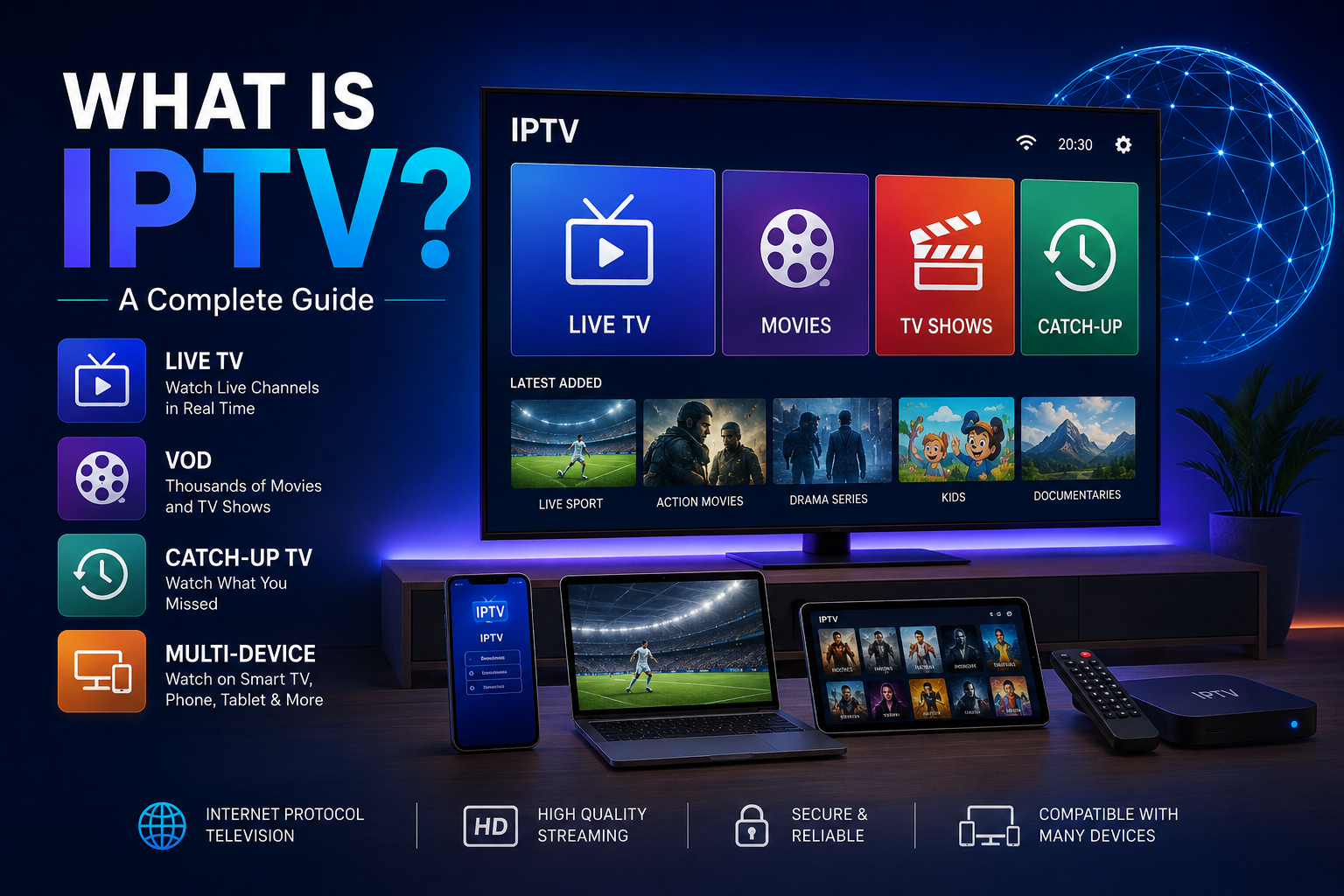
Internet Protocol Television, commonly known as IPTV, has changed the way people watch television. Instead of relying entirely on traditional broadcasting methods such as satellite dishes, cable networks, or terrestrial antennas, IPTV delivers television content through an internet connection.
With the rapid growth of high-speed internet, smart TVs, streaming devices, and mobile technology, IPTV has become an increasingly popular way to access live television channels, movies, TV shows, sports, and other forms of digital entertainment.
But what exactly is IPTV? How does it work? What are the different types of IPTV services? What devices can be used with IPTV? And what should users consider before choosing an IPTV service?
This comprehensive guide explains everything you need to know about IPTV, including its definition, technology, types, advantages, disadvantages, supported devices, and the difference between IPTV and traditional television.
What Is IPTV?
IPTV stands for Internet Protocol Television. It is a technology that allows television programs and video content to be delivered to viewers using an internet connection and Internet Protocol (IP).
Traditional television generally uses specific broadcasting infrastructures. Satellite television transmits signals through satellites, cable television uses physical cable networks, and terrestrial television uses radio frequencies.
IPTV works differently.
Instead of sending television signals through traditional broadcasting systems, IPTV uses internet networks to transmit video and audio data. The content is delivered from a server or content delivery system to the viewer’s device through an IP-based network.
In simple terms, IPTV means:
Television content delivered over an IP network.
Depending on the service, IPTV can provide several types of content, including:
- Live TV channels
- Video on Demand (VOD)
- Movies
- TV series
- Catch-up television
- Replay content
- Sports programming
- News channels
- International television channels
- Educational content
- Music channels
- Radio and multimedia services
One important point is that IPTV is a delivery technology, not necessarily a specific application or a particular subscription service. Many different providers and platforms can use IPTV technology to deliver content.
How Does IPTV Work?
Understanding how IPTV works is relatively simple.
When a viewer selects a television channel or video, the IPTV system receives the request and delivers the corresponding content through an IP network.
A typical IPTV system involves several important components.
1. Content Source
The process begins with the content itself.
Content may come from television networks, broadcasters, production companies, studios, or other legitimate content owners.
The content can include live television broadcasts, movies, series, sports events, or other video programming.
2. Encoding
Before video can be transmitted efficiently over an IP network, it usually needs to be processed and encoded into a suitable digital format.
Encoding reduces the amount of data required to transmit the video while maintaining an appropriate level of quality.
Modern streaming systems may use different video compression technologies depending on their infrastructure and compatibility requirements.
3. IPTV Server
The encoded content is distributed through servers or streaming infrastructure.
These servers are responsible for handling viewer requests and delivering the appropriate video streams.
Large services may use distributed server infrastructure and content delivery networks to improve performance and reduce buffering.
4. Internet Network
The video data travels through an IP-based network to the viewer.
This is where IPTV differs significantly from traditional satellite or terrestrial television.
The viewer does not necessarily need a satellite dish or traditional TV antenna. Instead, the content is delivered through an internet connection.
5. IPTV Application or Player
The viewer needs compatible software or an IPTV application to access the stream.
Depending on the device, this could be a smart TV application, mobile application, streaming player, set-top box, or another compatible IPTV client.
6. Television or Other Device
Finally, the content appears on the viewer’s screen.
This could be a smart television, Android TV device, computer, smartphone, tablet, or streaming box.
The Main Types of IPTV
IPTV is not limited to one type of television service. There are several major categories of IPTV and internet-based television services.
The most common types include:
- Live IPTV
- Video on Demand (VOD)
- Time-Shifted IPTV
- Catch-Up TV
- Near Video on Demand
- Subscription Video on Demand
- Transactional Video on Demand
- Ad-Supported Video on Demand
Let’s examine each type in detail.
1. Live IPTV
Live IPTV is one of the most recognizable forms of IPTV.
It allows users to watch television channels as they are being broadcast.
The concept is similar to traditional television, but the delivery method is different.
Instead of receiving the channel through a satellite signal, cable connection, or terrestrial antenna, the channel is delivered through an IP network.
Examples of live IPTV content can include:
- News channels
- Sports channels
- Entertainment channels
- Documentary channels
- Children’s channels
- International channels
- Music channels
- Local television channels
Live IPTV is particularly useful for viewers who want a traditional television experience while using an internet connection.
For example, someone may watch a live news broadcast at the same time it is being broadcast to other viewers around the world.
The quality of live IPTV depends on several factors, including internet speed, network stability, server capacity, video resolution, and the quality of the streaming infrastructure.
2. Video on Demand (VOD)
Video on Demand, commonly abbreviated as VOD, is another major category of IPTV.
Unlike live television, VOD allows users to choose content whenever they want.
Instead of waiting for a program to appear on a scheduled channel, viewers can select a movie, television episode, documentary, or other video from a library.
The basic concept is similar to having a digital video library.
A typical VOD platform may organize content into categories such as:
- Movies
- TV Shows
- Documentaries
- Action
- Comedy
- Drama
- Family
- Children’s content
- International movies
- New releases
VOD is one of the reasons internet-based television has become so popular.
Users have greater control over what they watch and when they watch it.
3. Time-Shifted IPTV
Time-shifted television allows viewers to watch programs at a different time from the original broadcast.
For example, imagine that a television program was broadcast at 8:00 PM.
With a time-shifted service, a viewer may be able to watch the program later instead of having to watch it at exactly 8:00 PM.
This feature is particularly useful for people who have busy schedules.
Time-shifting can provide more flexibility than traditional television broadcasting.
Depending on the platform, time-shifted content may be available for a limited period after the original broadcast.
4. Catch-Up TV
Catch-up TV is closely related to time-shifted television.
It allows users to watch previously broadcast programs after they have already aired.
For example, a television channel may broadcast a documentary on Monday evening. A viewer who missed it could use the channel’s catch-up feature to watch the program later.
Catch-up services are especially common on modern television platforms.
The availability period varies between services. Some programs may remain available for several days, while others may be accessible for longer periods.
Catch-up TV gives viewers greater flexibility because they do not have to organize their schedule around a television channel’s programming schedule.
5. Near Video on Demand
Near Video on Demand, or NVOD, is a system designed to provide scheduled content at frequent intervals.
Imagine that a movie begins every 15 minutes on different streams.
A viewer who wants to watch the movie does not necessarily have to wait for the next major scheduled broadcast. Instead, they can select the stream that is closest to the beginning of the movie.
NVOD was more common in earlier digital television systems, but the concept remains useful for understanding how television delivery technologies evolved.
Modern VOD platforms have largely reduced the need for NVOD because users can usually start content whenever they want.
6. Subscription Video on Demand (SVOD)
Subscription Video on Demand, or SVOD, is a business model where users pay a recurring subscription to access a library of content.
The subscription may be monthly, quarterly, or annual depending on the platform.
The user typically receives access to a collection of movies, TV shows, documentaries, or other content for the duration of their subscription.
SVOD has become one of the most popular forms of online video distribution.
The major advantage is convenience.
Instead of purchasing individual movies or programs, subscribers can access a broader catalog under one subscription.
However, the exact content available depends on the platform and the rights it has to distribute that content.
7. Transactional Video on Demand (TVOD)
Transactional Video on Demand, or TVOD, works differently from subscription-based services.
Instead of paying for unlimited access to a content library, the viewer pays for individual pieces of content.
For example, a user might pay to rent a movie for a limited period.
Another model allows the user to purchase a movie or program for longer-term access.
TVOD can be useful for content that is not included in a standard subscription library.
It gives users the ability to pay only for the specific content they want.
8. Advertising-Based Video on Demand (AVOD)
Advertising-Based Video on Demand, commonly known as AVOD, provides video content that is supported by advertising.
Instead of charging users directly for every piece of content, the platform generates revenue by displaying advertisements.
The viewer may be able to access some or all of the content without paying a traditional subscription fee.
The trade-off is that advertisements may appear before, during, or after the video.
AVOD has become an important part of the modern streaming ecosystem because it provides another way for platforms to monetize video content.
IPTV vs Traditional Television
One of the easiest ways to understand IPTV is to compare it with traditional television.
Satellite TV
Satellite television generally requires a satellite dish and compatible receiver equipment.
The television signal is transmitted from a broadcasting facility to a satellite and then to the viewer’s satellite dish.
IPTV does not require a satellite dish because content is delivered through an IP network.
Cable TV
Cable television uses a physical cable network to deliver channels to customers.
IPTV uses IP-based networks and internet connectivity.
Terrestrial TV
Terrestrial television broadcasts signals over the air using radio frequencies.
Viewers generally need an antenna and compatible television equipment.
IPTV
IPTV delivers content using IP networks.
This can provide additional interactive features, such as:
- On-demand content
- Catch-up television
- Electronic program guides
- Multiple device support
- Interactive menus
- Personalized recommendations
- Flexible playback
The exact features depend on the provider and platform.
What Devices Can Be Used for IPTV?
One of the biggest advantages of modern IPTV is its compatibility with many devices.
Depending on the service, IPTV can be accessed through:
Smart TVs
Many modern smart televisions support streaming applications.
Users can install compatible IPTV or streaming applications and connect the television to the internet.
Android TV Devices
Android TV and Google TV devices can support a wide range of streaming applications.
These devices are popular because they can turn a regular television into a connected smart entertainment system.
Streaming Boxes
Streaming boxes and media players can provide IPTV functionality on televisions that do not have built-in smart features.
Smartphones
IPTV applications can also be available for smartphones.
This allows users to watch compatible content while traveling or away from their main television.
Tablets
Tablets provide a larger screen than smartphones while maintaining portability.
They can be useful for watching live channels, movies, and other streaming content.
Computers
IPTV services can also be accessed through computers when the provider supports web-based playback or compatible applications.
Set-Top Boxes
Dedicated IPTV set-top boxes are designed specifically for television streaming and can provide features such as electronic program guides, channel lists, recording functions, and media playback.
What Internet Speed Is Needed for IPTV?
Internet requirements depend heavily on video quality.
Standard-definition video generally requires less bandwidth than high-definition or 4K video.
As a general guideline:
- SD streaming requires relatively low bandwidth.
- HD streaming requires a stronger and more stable connection.
- Full HD requires additional bandwidth.
- 4K streaming requires substantially more bandwidth and a reliable connection.
However, download speed is not the only factor.
A stable connection is equally important.
A connection with high theoretical speed can still experience buffering if it has:
- High latency
- Packet loss
- Wi-Fi interference
- Network congestion
- Unstable routing
- Poor server connectivity
For the best IPTV experience, users should have a reliable internet connection and, when possible, connect their television or streaming device through Ethernet or a strong Wi-Fi connection.
IPTV Streaming Quality
IPTV services can support different video resolutions.
Common resolutions include:
SD
Standard Definition uses relatively low bandwidth and can work well on smaller screens.
HD
High Definition provides a noticeable improvement in image quality and is widely used for television streaming.
Full HD
Full HD provides higher detail and is suitable for larger television screens.
4K Ultra HD
4K provides significantly higher image resolution and is increasingly common for premium streaming content.
However, not every channel or program is available in 4K.
The actual quality depends on the original source, encoding, server infrastructure, network connection, and playback device.
What Is an IPTV Player?
An IPTV player is software or hardware that allows compatible IPTV streams or content to be played on a device.
The player itself does not necessarily provide television channels.
Instead, it may function as a media player that connects to a legitimate IPTV service or content source.
Depending on the application, IPTV players may support features such as:
- Live TV playback
- VOD playback
- Electronic Program Guide (EPG)
- Favorites
- Multiple playlists
- Subtitles
- Parental controls
- Recording
- Playback history
The available features vary considerably between applications.
What Is an IPTV Subscription?
An IPTV subscription generally refers to a paid plan that provides access to a particular collection of television or video content through an IP-based service.
A subscription can include different combinations of:
- Live channels
- Movies
- TV series
- Sports programming
- Catch-up content
- VOD libraries
- International channels
However, consumers should always check what content a provider is legally authorized to distribute.
The legality of IPTV does not depend simply on whether the service uses internet technology. IPTV is a technology and delivery method. The important question is whether the provider has the appropriate rights and licenses for the content it offers.
Is IPTV Legal?
This is an important question for anyone researching IPTV.
IPTV technology itself is legal.
Many legitimate television companies, broadcasters, telecommunications companies, and streaming platforms use IP-based delivery.
The legal issue concerns the content being distributed and whether the provider has the necessary rights to distribute it.
A legitimate IPTV service should have authorization to provide the television channels, movies, sports, or other copyrighted material it offers.
Consumers should be cautious about services that advertise premium copyrighted content at unrealistic prices without clearly explaining their licensing arrangements.
Before subscribing to any IPTV service, users should research the provider and understand its terms, content rights, refund policy, privacy practices, and reputation.
Advantages of IPTV
IPTV offers several advantages compared with traditional television systems.
1. Flexible Viewing
Users can watch content on multiple compatible devices depending on the service.
2. On-Demand Content
VOD allows viewers to select movies and programs instead of relying entirely on fixed schedules.
3. Interactive Features
IPTV platforms can provide electronic program guides, search functions, recommendations, catch-up television, and other interactive features.
4. Multiple Content Categories
A single platform may provide access to different types of programming.
5. No Traditional Antenna Required
IP-based television does not necessarily require a satellite dish or terrestrial antenna.
6. Portable Viewing
Compatible services can allow users to watch content on smartphones, tablets, laptops, and other devices.
7. Advanced Features
Modern IPTV platforms can offer features that are difficult or impossible to provide through traditional broadcasting systems.
Disadvantages of IPTV
Despite its advantages, IPTV also has limitations.
1. Dependence on Internet Connectivity
If the internet connection fails, IPTV streaming may stop.
2. Buffering
Poor network performance can result in buffering or reduced video quality.
3. Server Problems
If the provider’s infrastructure is overloaded or poorly maintained, users may experience interruptions.
4. Compatibility Issues
Not every IPTV service works on every device.
Users should check device compatibility before purchasing a subscription.
5. Content Availability
Channels and programs depend on licensing agreements and geographic rights.
6. Legal Risks With Unauthorized Services
Using services that distribute copyrighted content without authorization can create legal and financial risks.
For this reason, consumers should choose legitimate providers.
IPTV and the Future of Television
The television industry continues to move toward internet-based delivery.
As broadband connections become faster and more widely available, viewers increasingly expect television to be flexible, interactive, and available across multiple devices.
Traditional scheduled television is still important, particularly for live news, sports, and major events. However, viewers increasingly combine live television with on-demand services.
This has created a hybrid viewing model.
A modern household may use:
- Live IPTV
- VOD
- Catch-up TV
- Streaming applications
- Traditional broadcast television
- Subscription services
- Free ad-supported services
The result is a television environment where viewers have greater control over what they watch and when they watch it.
How to Choose a Good IPTV Service
If you are considering an IPTV service, there are several factors worth evaluating.
1. Legitimacy
The most important consideration is whether the provider has the appropriate rights to distribute its content.
2. Channel Selection
Check whether the service provides the channels and categories you actually need.
3. Video Quality
Look for appropriate HD, Full HD, or 4K options where available.
4. Reliability
A good service should have stable infrastructure and minimize unnecessary interruptions.
5. Device Compatibility
Make sure the service works with your smart TV, streaming device, smartphone, computer, or set-top box.
6. Customer Support
Reliable customer support can be valuable when dealing with technical or account-related problems.
7. Pricing
Compare subscription prices with the features and legitimate content included.
An unusually cheap service offering access to large amounts of premium copyrighted content should be investigated carefully.
8. User Interface
A well-designed interface makes it easier to find channels, movies, and TV programs.
9. Electronic Program Guide
An EPG can make live television easier to navigate by displaying channel schedules and program information.
Common IPTV Features
Modern IPTV platforms can include many useful features.
Some common examples include:
Electronic Program Guide (EPG):
Shows information about current and upcoming programs.
Video on Demand:
Allows users to select movies and shows from a content library.
Catch-Up TV:
Allows previously broadcast programs to be watched later.
Favorites:
Lets viewers create personalized channel lists.
Multi-Device Support:
Allows compatible content to be accessed on different devices.
Parental Controls:
Can help parents restrict access to certain content.
Search:
Allows users to find channels, movies, or programs quickly.
Subtitles:
Some services support multiple subtitle languages.
Recording:
Certain platforms may support recording of compatible programs.
IPTV Security and Privacy
Users should also consider security when using internet-based television services.
It is important to download IPTV applications from trusted sources whenever possible.
Users should avoid suspicious applications that request unnecessary permissions or personal information.
A legitimate service should provide clear information about:
- Privacy policies
- Terms of service
- Account security
- Payment processing
- Data collection
- Customer support
Users should also avoid sharing account passwords unnecessarily.
As with any online service, strong passwords and good account security practices are recommended.
IPTV FAQs
Is IPTV the same as streaming?
IPTV is a form of delivering television and video content through IP networks. Streaming is a broader term that describes the delivery of media over networks. IPTV can therefore be considered part of the larger streaming ecosystem.
Can IPTV work on a Smart TV?
Yes. Many IPTV services and applications can work with compatible Smart TVs, although compatibility depends on the television model, operating system, application, and service.
Does IPTV require Wi-Fi?
Not necessarily. IPTV requires a network connection, but the device can often connect through Ethernet instead of Wi-Fi. Ethernet can provide a more stable connection in some situations.
Can IPTV be watched on a phone?
Yes, if the IPTV service provides a compatible mobile application or player.
Does IPTV require a satellite dish?
No. IPTV uses IP-based network connectivity rather than requiring satellite reception.
Is IPTV always paid?
No. IPTV can be delivered through different business models, including subscription-based, transactional, and advertising-supported services. Some legitimate broadcasters may also provide free internet-based television content.
Does IPTV work internationally?
It depends on the provider’s licensing agreements and geographic restrictions. Some services are designed for specific countries or regions.
Why does IPTV buffer?
Buffering can be caused by insufficient bandwidth, unstable internet connections, Wi-Fi interference, network congestion, server problems, or issues with the streaming source.
Final Thoughts
IPTV has become an important part of the evolution of television.
By using Internet Protocol networks to deliver television and video content, IPTV can provide a more flexible viewing experience than many traditional television systems.
The technology supports several different formats, including Live IPTV, Video on Demand, Time-Shifted TV, Catch-Up TV, SVOD, TVOD, AVOD, and other internet-based video services.
One of the biggest advantages of IPTV is its flexibility. Depending on the platform, viewers can access live channels, movies, television series, and other content across televisions, streaming devices, computers, smartphones, and tablets.
At the same time, IPTV depends heavily on internet connectivity and reliable technical infrastructure. Users should also pay close attention to content licensing and choose providers that are properly authorized to distribute the content they offer.
Ultimately, IPTV is not simply a replacement for traditional television. It represents a broader shift toward internet-based, flexible, interactive, and on-demand television.
As internet infrastructure continues to improve and consumers demand greater control over their viewing experience, IPTV and other IP-based television technologies are likely to remain an important part of the future of digital entertainment.